
KISIP project a game-changer
KISIP project a game-changer in improvement of informal settlements across 33 counties By Godffrey Olali
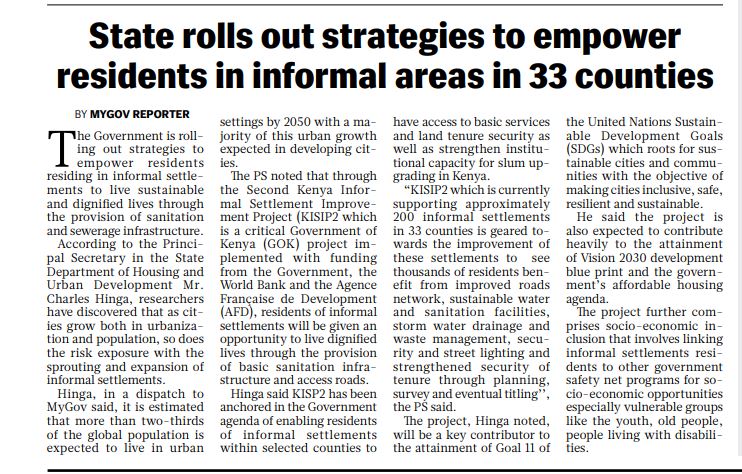
Kenya is progressively rolling out strategies which will empower residents residing in informal settlements live sustainable and dignified lives.
In fact, researchers opine that as cities grow both in urbanization and population, so does the risk exposure with the sprouting and expansion of informal settlements. Actually, it is estimated that more than two-thirds of the global population is expected to live in urban settings by 2050 with a majority of this urban growth expected in developing cities.
The Second Kenya Informal Settlement Improvement Project (KISIP2), a critical Government of Kenya (GOK) project, whose implementation is being implemented through funding by the State, the World Bank and the Agence Française de Development (AFD), has been anchored in the Government’s agenda of enabling residents of informal settlements within selected counties benefit by having access to basic services and land tenure security as well as strengthen institutional capacity for slum upgrading in Kenya.
KISIP2 which is currently supporting approximately 200 informal settlements in 33 counties, is geared towards improvement of these settlements, a move which will see thousands of residents benefit from improved roads network, sustainable water and sanitation facilities, storm water drainage and waste management, security and street lighting and strengthened security of tenure (planning, survey and eventual titling).
The project will be a key contributor to the attainment of Goal 11 of the United Nations Sustainable Development Goals (SDGs) which roots for sustainable cities and communities with the objective of making cities inclusive, safe, resilient and sustainable.
KISIP2 project is also expected to contribute heavily towards attainment of Vision 2030 development blue print and the government’s affordable housing agenda.
The project further comprises socio-economic inclusion that involves linking informal settlements residents to other government safety nets programs for socio-economic opportunities especially the vulnerable groups like the youth, old people, people living with disabilities.
“KISIP will propel Kenya towards achieving international declarations, key among them, the Sustainable Development Goals (SDGs) and specifically Goal 11 on “Making cities and human settlements inclusive, safe, resilient and sustainable” and the New Urban Agenda (NUA) which is a global blueprint providing guidelines for sustainable urbanization,” notes the PS, State Department for Housing and Urban Development Charles Hinga in a document.
The project which is currently domiciled at the State Department for Housing and Urban Development in the Ministry of Lands, Public works, Housing and Urban Development, is being implemented through participating county governments and in close partnership with other State agencies and stakeholders.
The primary project beneficiaries are the residents of the participating informal settlements, national and county government agencies.
Through the interventions, during the planning phases, the consultancies have engaged residents in the settlement to undertake non-technical jobs as well as buying items required for fieldwork from the local shops.
This is aimed at ensuring the project creates employment opportunities to thousands of youth in the country.
The project will also see national and county government agencies benefit through the institutional development activities aimed at strengthening capacity at the national and county levels to implement slum upgrading interventions.
Editor’s Note: This article was published on Tuesday, July 25, 2024 in MyGOV (Star Newspaper)